
What does being a child development specialist have to do with interior design?
Some people think it’s a unusual combo of expertise – understanding kids brains and curating beautiful homes – but others, especially parents, truly get it.
Once you have a child, it becomes quickly apparent that their environment matters. How you set up their sleep space, their play space, their feeding space, their comfort space…it all matters. Which then gets you thinking – “how can I do it well?” Because, let’s face it, they become your whole world and you would do anything to support them and help them thrive.
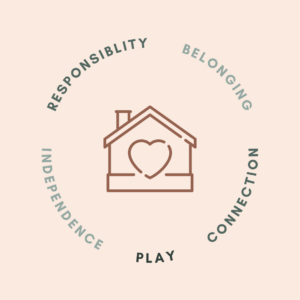
So, here are the areas I choose to focus on, and for good reason. Each has merit for a child’s development and wellbeing for life, something that most parents are desperate to promote.
Holding them in mind when I’m planning out spaces and making selections actually simplifies the process and weeds through the saturation of choices out there. As such, I’ll impart them to you for your own benefit as you go forth in curating the home you desire for your family.
RESPONSIBILITY
Designing with responsibility in mind means considering elements that promote organisation, ownership, and respect.
By offering child-friendly storage solutions and incorporating age-appropriate tasks, you can encourage children to take care of their spaces and belongings, teaching them valuable life skills.
Allowing them to have a say in their personal spaces fosters a sense of ownership and responsibility. They are more likely to take care of their belongings and living areas when they feel a sense of ownership.
- Provide age-appropriate storage solutions for your child’s belongings, such as shelves, bins, and hooks. Teach them how to put away their toys, clothes, and books in designated places.
- Teach your child about environmental responsibility by incorporating eco-friendly elements into your home design.
- If you have pets, design a pet care area where your child can take responsibility for feeding, grooming, and cleaning up after them.
- Visual charts help so much – invest in ones that aren’t ugly and that make you resent them!
BELONGING
Designing spaces that give children a sense of belonging and ownership is crucial for their comfort and security.
By incorporating personalised elements and considering their preferences and interests, you can make children feel like an integral part of their living spaces.
- Showcase family photos.
- Display your child’s artwork, certificates, and accomplishments in a prominent area. Recognise and celebrate their achievements – it creates a sense of pride.
- Involve them in decision making, let them know that their opinions and preferences are valued, and their voice matters.
- Having a space that feels uniquely theirs will make them feel more connected to the home.
- Invite people over that matter to your children; they love showing off their things. Encourage your child to invite their friends to play and visit. Being able to share their home with friends helps them feel proud of their living space and fosters a sense of belonging within their social circle.
- Make home safe and secure for them.
INDEPENDENCE
Designing spaces that support a child’s independence is empowering and boosts their confidence and self-esteem.
We can’t just assume that kids will do things for themselves without having multiple opportunities to observe and practice.
Consider the layout and accessibility of various elements within the environment so that children can easily navigate and access things on their own. This can include child-friendly furniture, open shelves, and reachable storage.
- Your home needs to be set up for role modelling and repetition.
- When children can independently manage basic tasks like dressing, tidying their rooms, or getting a snack, it reduces the reliance on parents for every small thing.
- A learning tower encourages them to cook. As you’re preparing it, they can set the table for eating together.
- Make the kitchen safe enough to do dishes and systematised enough so that they can put things away.
- Laundry hampers, not the floor, are for dirty clothes.
- Set up a learning space and a designated spot for school belongings.
Offer them the freedom to explore their environment and let them regulate how they use it. It encourages problem-solving and critical thinking skills. They learn to adapt, make decisions, and find solutions to everyday challenges.
PLAY
Play is essential for children’s cognitive, emotional, and physical development. Designing spaces that follow your child’s lead and preferences enhances their learning and overall wellbeing.
- Incorporating versatile furniture, designated play areas, and interactive elements will contribute to a stimulating environment.
- Play is not just about having toys. Play is how children learn. And the need for play in a family home doesn’t go away.
- Accommodating play means creating physical space and time to do things that bring joy. There are SO many examples of what constitutes play.
- Making up games
- Building blocks
- Make believe/role play
- Dress ups
- Board games
- Dance parties
- Creating LEGO masterpieces
- Drawing and crafting without boundaries
- Artistic expression
- Music – listening and creating
- Climbing
- Cooking
- Sport
- Video games
- Hobbies
- Puzzles.
Throughout the lifespan, the form of play may change, but its positive effects remain. It’s important to prioritise play in your home design, well beyond the toddler years.
CONNECTION
This principle involves designing spaces that foster meaningful connections between children and their surroundings, as well as with others.
Creating cosy and inviting areas where children can interact with family members, friends, and even pets can enhance their social skills and emotional development.
- Proactively allocate space to connect with each other. Consider chairs, comfortable seating, quiet corners and being down at your child’s level.
- Set up your space to easily engage in shared experiences. Think about your child’s interests and your interests that overlap, e.g., cooking, reading, playing, sports, art, music, etc.
- Opt for an open layout that promotes togetherness.
- Incorporate photo galleries or memory walls where you display family photos, artwork, and memorabilia. This can spark conversations about fond memories and promote bonding.
- Set tech-free zones for uninterrupted and quality connection.
- Think of your unique family rituals and ensure your home is designed to facilitate them.
- Consider the routines pre and post separation, i.e., before and after school/care. Setting up systems and clear processes frees up time to connect meaningfully.
Understanding the pivotal role of child development in family-friendly interior design is the first step toward creating spaces that truly enhance the lives of your loved ones.
By focusing on these five key areas, you’ll not only craft environments that foster growth but also nurture meaningful connections and lasting memories. As you embark on your own design journey, I invite you to follow me for more specialist insights, practical tips, and creative solutions that will empower you to transform your home into a haven of warmth, safety, and endless possibilities. Your family deserves nothing less than the very best, and I’m here to guide you every step of the way.