

You may have heard the term neuroaffirming becoming more common in education, therapy, and parenting spaces. But what does neuroaffirming design actually mean when we’re talking about homes?
Put simply, neuroaffirming design means creating environments that respect, support, and accommodate different ways of thinking, sensing, regulating, and interacting with the world, rather than expecting people to adapt themselves to the environment.
It recognises that there is no single “right” way to experience a home.
And importantly, neuroaffirming design is not only for neurodivergent families. Many of the principles support all children and adults, because every nervous system benefits from clarity, predictability, comfort, and a sense of belonging.
This is why neuroaffirming design overlaps so strongly with family-friendly, functional, and inclusive interior design.
The shift from “fixing behaviour” to supporting regulation
Traditionally, environments for children (particularly neurodivergent children) have often been designed around managing behaviour.
A neuroaffirming approach instead asks:
What is the environment communicating?
What sensory demands exist in this space?
What is making regulation easier or harder?
How can the space support independence and safety?
This reflects what we know from research across child development, occupational therapy, and neuroscience: environment strongly influences regulation, attention, participation, and wellbeing.

When a space aligns with a child’s sensory profile and developmental stage, we often see:
reduced stress and overwhelm
more independence
smoother routines
increased confidence
fewer daily friction points for families
Not because the child has changed — but because the environment is working with them instead of against them.
What neuroaffirming design looks like in everyday homes
Neuroaffirming design is rarely about expensive renovations or specialised equipment. Most of the time, it shows up in small, thoughtful decisions.
For example:
Predictability and visual clarity
clear storage systems children can understand
consistent locations for everyday items
uncluttered pathways
defined zones for play, rest, and activity
Sensory awareness
softer lighting instead of harsh overhead lights
textures that feel comfortable and safe
reducing visual noise where possible
creating quiet retreat spaces
Supporting regulation
cosy corners or calming spaces
movement opportunities (like swings, floor cushions, or open play space)
furniture scaled for children
spaces that allow both connection and alone time
Independence and agency
accessible storage
hooks, drawers, and systems children can use themselves
bedrooms that reflect identity and growing autonomy
layouts that support daily routines

These ideas align closely with universal design principles – environments that work for the widest range of people without needing adaptation later.
Neuroaffirming design is not a “look”
One of the biggest misconceptions is that neuroaffirming design has a particular aesthetic.
It doesn’t.
A neuroaffirming home might be:
calm and neutral
colourful and playful
minimal
layered and textural
contemporary or traditional
What matters is not the style, but whether the space supports the people living in it.
This is why comparison between families can be so unhelpful. A layout or design choice that works beautifully for one child may be completely wrong for another.
Designing for real families means considering:
personality
temperament
sensory preferences
developmental stage
family routines
practical needs
There is no one-size-fits-all solution.
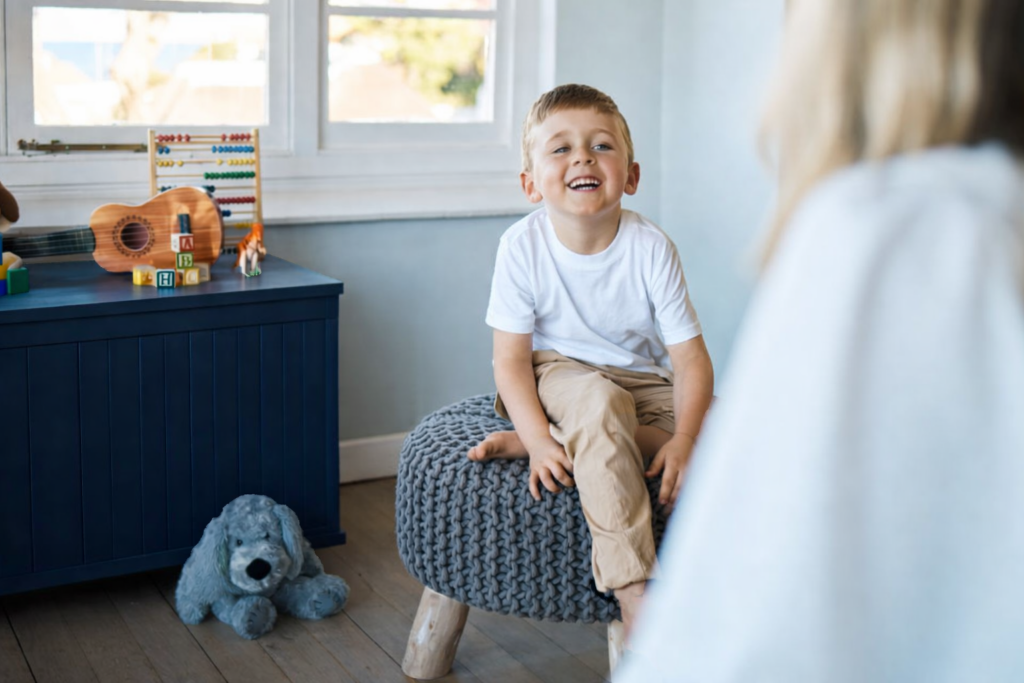
The goal is not perfection!
A neuroaffirming home is not a perfect home.
It is a home that feels:
safe
supportive
manageable
responsive to the people living in it
Sometimes this means making practical choices that prioritise function over aesthetics.
Sometimes it means letting go of design rules that don’t serve your family.
And sometimes it simply means noticing what is already working, and doing more of that.
Because when environments support regulation, independence, and belonging, homes become easier places to live in.
For children and for parents.